
A-level Congratulations Messages That Don't Sound Generic
01/11/2026
Card messages to copy for a daughter, son or friend finishing sixth form, funny wishes and how to turn a cliché into a line only you could write.
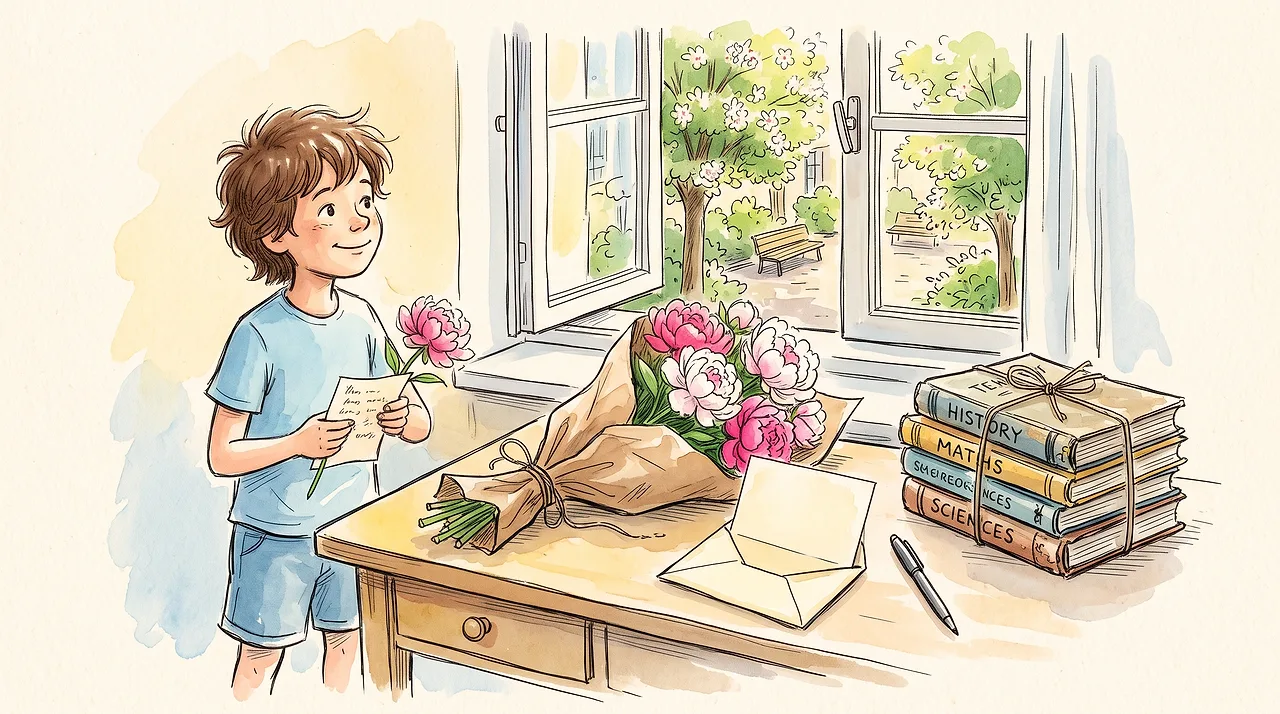
A good A-level congratulations message does three things: it recalls one specific moment from sixth form, it recognises hard work and persistence (not the grade) and it says something about what comes next. Two or three sentences are enough. Feel free to skip lines like "Best of luck for the future" — they'll get a dozen of those that week and won't remember a single one.
Why A-level cards sound like they came off the shelf
A shop-bought message is easy to spot: you could send it, word for word, to any other student finishing sixth form anywhere in the UK. "Congratulations on your excellent results and best wishes for your studies and your future" says nothing about who it's for, or who wrote it.
There are three common mistakes. First, congratulating only the grades — they'll remember the late nights over past papers and the walk to the exam hall far more than a B in chemistry. Second, wishing for an entire life — "may all your dreams come true" is so broad it hits none of them. Third, signing off "Your loving parents" when they've called you "Mum" for eighteen years.
It doesn't take much. One sentence that only you could write turns a card into something they'll keep in a drawer. Usually it's a memory ("I remember you getting lost in the building on your first day"), specific praise ("you caught the first train every morning all year and never once complained") or a look ahead ("Manchester's waiting for you in the autumn and I already know which café I'll be stopping at by the station").
How to write an A-level card in five minutes
- 1Pick one momentNot the whole of sixth form — one scene. The calculator that went missing before the maths paper, the leavers' prom, the first day in a new form, a weekend buried in set texts.
- 2Recognise what you sawPersistence, courage, a sense of humour in the worst week. You often write the card before results are out — praise for the effort holds true however the exams go.
- 3Say something about what comes nextUniversity, a job, a year abroad, a gap year. If they still don't know, tell them it's fine not to know — from a parent, that's often the most valuable line on the card.
- 4Add one line that's only from youWhat they've given you, what it's been like living with them, what you're looking forward to. This is the sentence nobody else can write.
- 5Sign off the way they address you"Mum and Dad", "Grandma [Pat]", "Your auntie, who once banned you from the kitchen". Skip the formal sign-off — write the name they actually use for you, and the card instantly sounds like you.
A-level congratulations for a daughter or son from parents
Swap the square brackets for your own memory. Each message fits on a card in an envelope.
A-level messages from grandparents, godparents and friends
Grandparents and godparents have an advantage: they've known the student since the cradle and they're allowed to say so.
Funny A-level congratulations messages
Humour works when it's about the student, not at their expense. Save the jokes about failing for when you know for certain they've passed.
Good luck messages before the A-level exams
Before the exams, "you'll walk it" doesn't help — it sounds as if it doesn't matter. It's better to show that you can see how much work has gone into it, and that the result won't change anything between you.
When the results didn't go to plan, or you don't know them yet
Not everyone gets the results they hoped for first time — and a card written in advance, full of congratulations on success, can hurt more than it helps. A disappointing result isn't the end of the road: exams can be taken again and there's usually more than one way to the same place, so it's a detour, not a dead end.
If you're handing over a card on the last day of exams or at a leavers' do before results, write about the work and the person, not the outcome: "we're proud of you for everything you put into sixth form" is always true. If you already know it didn't work out, skip the congratulations and write something like: "One set of results doesn't change who you are. You'll get there, and we'll be waiting outside just like today." Save the jokes for later, once it's behind them.
What to write when the card comes with a gift or money
- With moneySay what it's for, or say outright that it isn't for anything in particular: "For your first rent, or for a trip you choose yourself." How to give money so it doesn't vanish in a weekend is covered in the article how to give money as a gift.
- With a presentLink the present to what they're doing next — ideas for university, work or a gap year are in the article gifts for finishing school. Then one line in the card about why you chose this is enough.
- With a bookA book inscription works differently from a card: it stays with the book for years. Rules and examples are in the article book inscriptions. If you'd like to remind them of their childhood, you can also give a personalised book featuring them as drawn from a childhood photo — you write the inscription straight into the wizard and the e-book is usually ready within 15 minutes.
- For A-levels and an 18th at the same timeWhen both milestones fall in the same year, don't merge them into one line. Messages for coming of age are in the article 18th birthday wishes, and for the next milestone see graduation messages.
Sources
- Debrett's — Forms of address and sign-offs in letters and cards.
- Oxford English Dictionary and New Hart's Rules (New Oxford Style Manual) — Spelling and punctuation in personal messages, including names and possessives.